How a Holographic Sight Actually Works
A holographic sight does not reflect a lit dot off a mirror. It replays a recorded hologram with laser light. Here is what each part of the light path does, and how that differs from an LED reflex sight.
From a few metres away, a holographic sight and an LED red dot sight look like the same kind of thing: a small window on a rail with a glowing reticle that seems to float out over the target. Inside, they work on different principles. One reflects light from a lit point. The other replays a recording of light. This is the first part of our How Optics Work series, which explains the physics behind the optics covered in our landscape of smart weapon sights, and it starts with the device whose name is used most loosely.
Start with the reflex sight
The common red dot is a type of reflector (or "reflex") sight. A small light-emitting diode shines through, or acts as, a tiny aperture. That point of light sits at the focal point of a curved, partially reflecting mirror that is tilted slightly so the source can sit off to one side, out of the way of the view. The mirror carries a coating that reflects the LED's colour strongly while letting most other light through. Light from a point at the focus of a concave mirror leaves it as a parallel (collimated) beam, so the eye sees the dot as if it were very far away, overlaid on the scene (Wikipedia: Red dot sight; Wikipedia: Reflector sight; Holosun).

Try itDrag the LED off the focal point. The reflected rays stop being parallel and the dot in the eye view smears.
Figure 1. An LED reflex sight. The lit aperture sits at the mirror's focal point, so its reflection leaves as parallel rays and the dot appears far away. The reticle is simply the shape of the lit aperture. Schematic, not to scale. In the interactive, the mirror is drawn with a 25 mm focal length and the image distance comes from the mirror equation.
Two things follow from this design. First, the reticle is the image of whatever shape is lit: a dot, a ring, or a simple pattern etched into the aperture. Second, everything the eye sees of the reticle comes from a single small source reflected by one surface. That is a simple, robust arrangement, and it is why reflex sights are so common.
What a hologram is
A hologram is a recording of light itself rather than of a picture. To make one, a laser beam is split in two. One part (the object beam) lights an object, and the light scattered from it falls on a photosensitive plate. The other part (the reference beam) goes straight to the same plate. Because laser light is coherent, the two beams interfere and leave a fine pattern of fringes in the plate, far too small to see. That pattern encodes both the brightness and the direction of the light that came from the object (OpenStax University Physics, Vol. 3: Holography; Wikipedia: Holography).
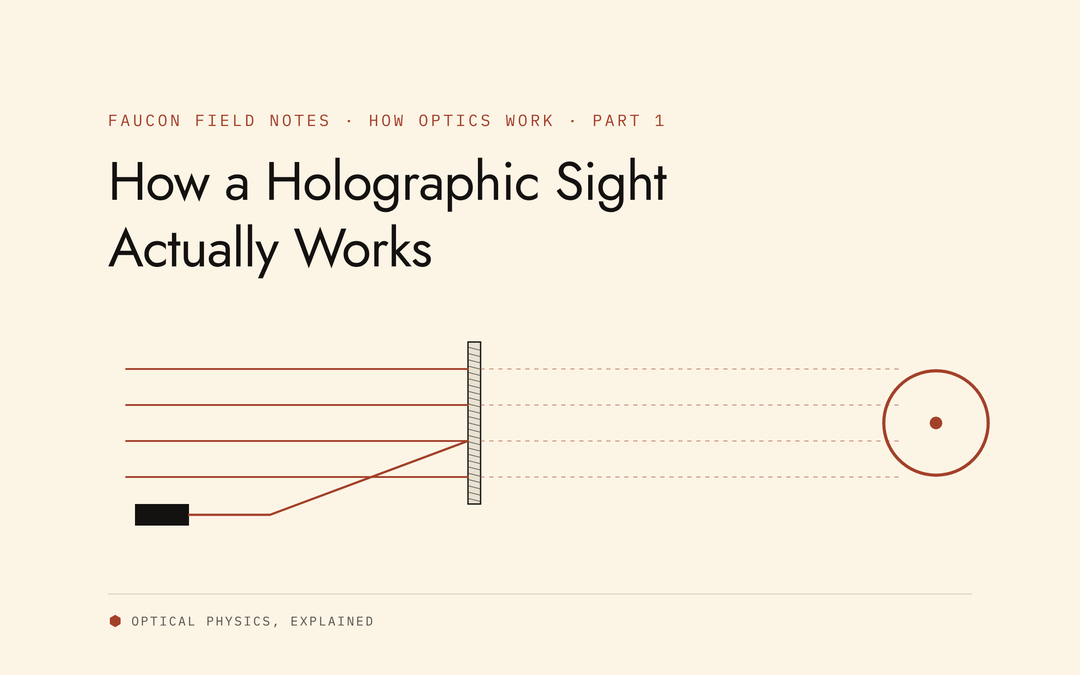
To replay the hologram, you shine a beam like the original reference beam onto the developed plate. The recorded fringes act as a complicated diffraction grating. They bend part of the light into the same wavefront that originally came from the object. To the viewer, light appears to come from where the object was, at the same distance and with the same depth, even though the object is gone (OpenStax; OpenStax: Diffraction gratings).

Try itWatch the two beams interfere and expose the plate, then switch to Replay. Change the reference angle to see the fringes tighten.
Figure 2. Recording and replaying a hologram. During replay, the plate diffracts the reference beam into a copy of the original object wavefront, so the eye sees the reticle where the object was. Schematic, not to scale. The waves are drawn far larger than real light waves. The fringe spacing shown is calculated for 650 nm light.
Inside a holographic sight
A holographic weapon sight uses this idea for its reticle. During manufacture, the reticle object (for example, a ring with a central dot) is recorded into a hologram, with the reticle image placed some distance in front of the sight. In use, a laser diode replays it, and the shooter sees the reticle image hanging out over the scene (Wikipedia: Holographic weapon sight).
EOTech's patent US 6,490,060 describes one compact layout. Light from a laser diode is folded by a mirror, broadened and collimated by an off-axis collimator, and reflected by a reflection diffraction grating onto the reticle hologram in the viewing window. The hologram diffracts that light toward the user's eye, forming the reticle image. In this design, windage and elevation adjustments move the reticle by rotating the reflection grating (US 6,490,060 B1, Google Patents).

Try itHeat or cool the sight, then swap the grating for a plain mirror. Without the grating the reticle walks off the target.
Figure 3. A holographic sight's light path, simplified from the arrangement described in US 6,490,060. The parts are drawn spread out for clarity; real sights fold this path into a small housing. Schematic, not to scale. In the interactive, the laser drifts by an illustrative 0.25 nm per °C and the hologram has an illustrative 919 nm fringe period. The colour change and beam angles are exaggerated.
Why the grating is there
The grating is the most interesting part of the design, and the reason for it is physical rather than cosmetic. A diffraction grating, including the fringe pattern in a hologram, bends light by an angle that depends on wavelength. Laser diodes do not emit one fixed wavelength. Their output shifts as temperature changes (Wikipedia: Laser diode). If the laser drifts in wavelength, the hologram bends the light by a slightly different angle, and the reticle appears to move.
The fix described in the patents is to put a second diffractive element in the path, with dispersion that opposes the hologram's. When the wavelength drifts, the grating changes the angle at which light reaches the hologram by just enough to cancel the change the hologram would otherwise introduce. US 6,490,060 does this with a reflection grating. An earlier patent, US 5,483,362, from inventors at the Environmental Research Institute of Michigan, describes "achromatizing means" that use a diffraction grating between the collimating lens and the hologram, so as to reduce "shifts in the position of the reticle pattern due to variations in the wavelength of the light beam" (US 5,483,362, Google Patents; US 6,490,060 B1).
In other words, a holographic sight is not just a laser in a box. It is a small diffractive optical system designed so that two wavelength-dependent errors cancel.
What the eye sees
Because the reticle is a reconstructed wavefront, it can be any pattern that can be recorded, and it can be recorded so that it appears at a chosen distance in front of the sight. Maker material describes this as letting the user keep both eyes open and see the reticle and target in focus together (EOTECH: Holographic sights learn page). The physics of why a reticle can look far away is the same for holographic and reflex sights. Both send collimated (or nearly collimated) light to the eye.
EOTECH also says its sights keep working when the window is "partially shattered or obscured by snow or mud". That is a maker claim, and we report it as one. It fits the way a hologram spreads the reticle's information across the recording instead of holding it in one spot, but we have not tested it (EOTECH: Holographic sights learn page).
Neither design is perfectly free of reticle movement when the eye moves. EOTECH's own help centre says off-axis parallax in its sights "might be up to 4±3 MOA" at 71 °F, with an additional amount at temperature extremes, and calls it "a common misconception that red dot or holographic sights are parallax free" (EOTECH Help Center).

Why "holographic" is not just a floating red dot
Put side by side, the two designs differ in three ways.
| LED reflex sight | Holographic sight | |
|---|---|---|
| Light source | LED (incoherent, relatively broad spectrum) | Laser diode (coherent, narrow spectrum) |
| How the reticle is formed | Reflection of a lit aperture by a curved, coated mirror | Diffraction of laser light by a recorded hologram |
| What sets the reticle shape | The aperture or LED shape | Whatever was recorded in the hologram |
| Main wavelength issue | Coating must reflect the LED's colour | Diffraction angle shifts with wavelength, so a compensating grating is used |
The table is about mechanism, not merit. Each approach has costs. A laser diode and a compensating grating add parts and design constraints. A reflex sight's simplicity is a real advantage. Battery life, brightness range and durability vary from product to product, so we do not generalise about them here.
One more caution on vocabulary. "Holographic" is sometimes used in marketing for sights that are LED reflex designs. In the strict sense, the term refers to sights that replay a recorded reticle hologram with laser light, as described above (Wikipedia: Holographic weapon sight). When we catalogued the market in our landscape article, we kept the two categories separate for that reason.
Key points
- An LED reflex sight puts a lit point at the focus of a curved, partially reflecting mirror. The reflected rays leave parallel, so the dot appears far away.
- A holographic sight replays a recorded hologram of the reticle with laser light. The eye sees a reconstructed image at the distance where it was recorded.
- Holograms diffract light at angles that depend on wavelength, and laser diodes drift with temperature. Holographic sight patents describe a compensating grating to cancel that drift.
- Neither type is completely free of parallax. The maker's own figures say so.
Sources
Every source below was opened and checked on 6 November 2026.
- Wikipedia, "Red dot sight": https://en.wikipedia.org/wiki/Red_dot_sight
- Wikipedia, "Reflector sight": https://en.wikipedia.org/wiki/Reflector_sight
- Holosun Europe, "About reflex sights": https://www.holosun.eu/en/About-Reflex-Sights/
- OpenStax, University Physics Volume 3, 4.7 "Holography": https://openstax.org/books/university-physics-volume-3/pages/4-7-holography
- Wikipedia, "Holography": https://en.wikipedia.org/wiki/Holography
- OpenStax, University Physics Volume 3, 4.4 "Diffraction Gratings": https://openstax.org/books/university-physics-volume-3/pages/4-4-diffraction-gratings
- Wikipedia, "Holographic weapon sight": https://en.wikipedia.org/wiki/Holographic_weapon_sight
- Tai and Sieczka (EOTech), US Patent 6,490,060 B1, "Lightweight holographic sight": https://patents.google.com/patent/US6490060B1/en
- Wikipedia, "Laser diode": https://en.wikipedia.org/wiki/Laser_diode
- Tai, Upatnieks and Sieczka, US Patent 5,483,362, "Compact holographic sight": https://patents.google.com/patent/US5483362A/en
- EOTECH, "Holographic sights: learn": https://www.eotechinc.com/pages/eotech-holographic-sights-learn
- EOTECH, Help Center (parallax FAQ): https://www.eotechinc.com/pages/help-center
- DVIDS, image 1870175 (U.S. Marine Corps photo, public domain): https://www.dvidshub.net/image/1870175