Why the Reticle Looks Far Away
The glowing reticle in a sight is a few centimetres from your eye, yet it looks as far away as the target. The trick is collimation. Here is how it works, and why the apparent distance of an overlay matters so much.
How Optics Work, Part 2. Earlier in the series: Part 1: How a Holographic Sight Actually Works.
Hold a finger a hand's width from your face and look past it at a far wall. The finger blurs and doubles. Your eyes can focus near or far, but not both at once. Yet when you look through a red dot sight, a head-up display (HUD) or the holographic sight from Part 1, the reticle is a few centimetres from your eye and still looks sharp at the same time as a distant target. This article explains why. The answer is collimation, which produces what optics calls a virtual image.
How your eye focuses
The eye focuses by changing the shape of its lens, a process called accommodation. The nearest point at which it can form a sharp image is the near point. OpenStax gives the range of normal vision as about 25 cm to "essentially infinity". The near point moves further away with age (OpenStax University Physics, Vol. 3: The Eye; Wikipedia: Accommodation).
Optical designers measure focus in diopters, the reciprocal of the distance in metres. An object at 25 cm needs 4 diopters of focus. An object at 1 m needs 1 diopter, one at 10 m needs 0.1 diopter, and one at infinity needs zero (Wikipedia: Dioptre). The scale is very compressed at long range. Everything from about 10 m to the horizon falls within a tenth of a diopter, which is why distant objects all look sharp at once, while a near object pulls focus away from them.

Try itDrag the focus marker along the diopter scale. Then switch the reticle from a bare source to collimated light.
Figure 1. Focus demand in diopters (1 ÷ distance in metres). A target at 50 m and one at 500 m differ by less than 0.02 D. A reticle at 5 cm would need 20 D, far outside any eye's range.
So the problem a sight has to solve is simple to state. A light source a few centimetres away would need tens of diopters of focus. It has to be made to look like it is near zero diopters, where the target is.
Collimation: making near light look far
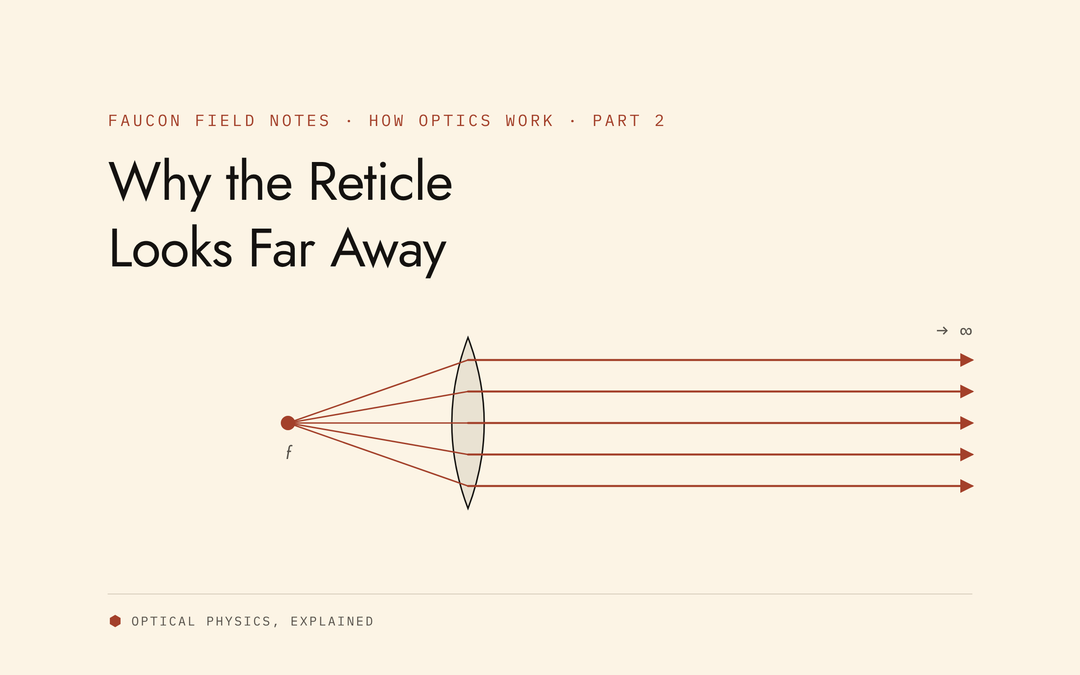
Light from a single distant point arrives at the eye as nearly parallel rays. Light from a near point spreads out (diverges) noticeably. The amount of divergence is what sets how much the eye has to accommodate: parallel rays need none at all. So if an optic can take the diverging light from a nearby source and make its rays parallel, the eye will treat the source as if it were at infinity. That is what a collimator does (Wikipedia: Collimator; Wikipedia: Collimated beam).
The simplest collimator is a converging lens with the source placed exactly at its focal point. Rays from the focal point leave the lens parallel. A concave mirror does the same: a source at its focal point (half the radius of curvature) reflects as a parallel beam. This is the arrangement inside a reflex sight (OpenStax: Thin Lenses; OpenStax: Spherical Mirrors).

Try itDrag the source through the focal point. Then use the fine slider to move it a fraction of a millimetre inside.
Figure 2. Where the source sits relative to the focal point decides where the image appears. At the focal point, the rays are parallel (collimated). Just inside it, they appear to come from a virtual image some distance away. Schematic, not to scale.
The image formed this way is virtual. No light actually comes from the place where the reticle seems to be. The eye traces the rays it receives back to a common point and perceives the reticle there (Wikipedia: Virtual image). That is why the reticle can seem to sit out on the target while the hardware sits on the rail.
Choosing a finite distance
Designers do not always put the image at infinity. The thin-lens equation, 1/f = 1/do + 1/di, shows what happens when the source sits slightly inside the focal length (OpenStax: Thin Lenses). Take an illustrative lens with f = 100 mm:
| Source distance from lens | Image distance (virtual) | Focus demand |
|---|---|---|
| 100.0 mm (at focus) | infinity | 0 D |
| 99.9 mm | about 100 m | 0.01 D |
| 99.0 mm | about 9.9 m | 0.10 D |
| 95.0 mm | about 1.9 m | 0.53 D |
Worked from the thin-lens equation for an illustrative 100 mm lens. These are not specifications of any product.
Two lessons come out of this table. First, a tiny shift in source position moves the apparent image a long way. Moving the source just 0.1 mm takes the image from infinity to about 100 m. Building a sight that puts the reticle at a chosen distance is therefore a matter of tight mechanical tolerances. Second, the eye barely notices the difference between infinity and 100 m in focus terms, but the choice still matters for how the reticle lines up with targets at different ranges. Reflex sight makers often state the distance at which a sight is set to be parallax-free, and some choose a finite distance rather than infinity (Wikipedia: Red dot sight; Vector Optics Academy).
Holographic sights reach the same result by a different route. The reticle hologram is recorded so that its reconstructed image appears at a chosen distance in front of the sight (Wikipedia: Holographic weapon sight). The physics of what the eye receives, light that appears to come from far away, is the same.
Why the overlay's apparent distance matters
If the eye cannot tell infinity from 100 m in focus, why does any of this matter? There are three reasons.
Focus. If an overlay sits at a very different focal distance from the scene, the eye has to choose which to keep sharp. A collimated or near-collimated overlay avoids that choice. Magnified telescopic sights handle the same issue with an eyepiece diopter adjustment, which lets each user focus the reticle sharply for their own eye (Wikipedia: Telescopic sight).
Both eyes. With both eyes open, the eyes also converge (turn inward) on whatever they look at. A near object needs more convergence than a far one. If an overlay appears at a different distance from the scene behind it, the two eyes see it in slightly different places relative to the scene. The brain then has to fuse the views or tolerate a doubled image. In headsets, a mismatch between where the eyes converge and where they focus is known as the vergence–accommodation conflict, and it is linked to visual discomfort and fatigue (Wikipedia: Vergence–accommodation conflict).

Try itSlide the overlay out toward the target and watch the doubled image merge.
Figure 3. With both eyes open, an overlay that appears at 2 m needs much more convergence than a target at 50 m (about 32 mrad versus 1.3 mrad for a 64 mm eye spacing). An overlay near the target's distance avoids the mismatch. Schematic geometry.
Registration. For an overlay to stay on the thing it marks, its apparent position must not slide when the head or eye moves. For distant scenes, the way to do that is to collimate the overlay so it behaves like a distant object. Aircraft HUDs collimate their symbology for exactly this reason: so that symbols lie on the outside world and the pilot does not need to refocus between the display and the view (Wikipedia: Head-up display). How well that registration holds when the eye moves depends on how precisely the light is collimated.
Key points
- The eye focuses by accommodation, measured in diopters (1 ÷ distance in metres). Everything beyond about 10 m lies within 0.1 diopter of infinity.
- Placing a source at the focal point of a lens or mirror makes its light parallel, so the eye perceives it at infinity. This is collimation.
- Placing the source slightly inside the focal point produces a virtual image at a finite distance. Small mechanical shifts move that distance a long way.
- The apparent distance of an overlay affects focus, binocular comfort and how well it stays registered on the scene.
Sources
Every source below was opened and checked on 6 November 2026. Worked numbers are our own calculations from the equations cited.
- OpenStax, University Physics Volume 3, 2.5 "The Eye": https://openstax.org/books/university-physics-volume-3/pages/2-5-the-eye
- Wikipedia, "Accommodation (vertebrate eye)": https://en.wikipedia.org/wiki/Accommodation_(vertebrate_eye)
- Wikipedia, "Dioptre": https://en.wikipedia.org/wiki/Dioptre
- Wikipedia, "Collimator": https://en.wikipedia.org/wiki/Collimator
- Wikipedia, "Collimated beam": https://en.wikipedia.org/wiki/Collimated_beam
- OpenStax, University Physics Volume 3, 2.4 "Thin Lenses": https://openstax.org/books/university-physics-volume-3/pages/2-4-thin-lenses
- OpenStax, University Physics Volume 3, 2.2 "Spherical Mirrors": https://openstax.org/books/university-physics-volume-3/pages/2-2-spherical-mirrors
- Wikipedia, "Virtual image": https://en.wikipedia.org/wiki/Virtual_image
- Wikipedia, "Red dot sight": https://en.wikipedia.org/wiki/Red_dot_sight
- Vector Optics Academy, "Parallax-free red dot sight": https://www.vectoroptics.com/Academy/parallax-free-red-dot-sight-vectoroptics.html
- Wikipedia, "Holographic weapon sight": https://en.wikipedia.org/wiki/Holographic_weapon_sight
- Wikipedia, "Telescopic sight": https://en.wikipedia.org/wiki/Telescopic_sight
- Wikipedia, "Vergence–accommodation conflict": https://en.wikipedia.org/wiki/Vergence-accommodation_conflict
- Wikipedia, "Head-up display": https://en.wikipedia.org/wiki/Head-up_display