Parallax Explained: Why the Dot Can Move When Your Eye Moves
Move your head behind a red dot and the dot moves too. Some of that is harmless and some is real offset on the target. Here is the geometry that separates the two, and why 'parallax-free' always comes with conditions.
How Optics Work, Part 3. Earlier in the series: Part 1: How a Holographic Sight Actually Works and Part 2: Why the Reticle Looks Far Away.
Look through a red dot or holographic sight and move your head a little from side to side. The dot slides around inside the window. Is the sight now pointing somewhere else? Usually it is not, or only by a small amount. Separating the movement that does not matter from the movement that does is the whole subject of parallax in sights. It follows directly from the collimation described in Part 2.
What parallax is
Parallax is the apparent shift of an object against its background when the viewpoint moves. Close one eye, then the other, while holding up a finger, and the finger jumps against the far wall. The nearer the object, the bigger the jump (Wikipedia: Parallax). In a sight, the question is whether the reticle behaves like a far object (no jump against the target) or a near one (a jump).
There are two kinds of movement to keep apart, a distinction that maker guides also draw (Primary Arms: Parallax and red dots):
- Movement within the window. The dot appears in a different part of the glass as your eye moves. This is normal and expected.
- Movement against the target. The dot lands on a different point of the target as your eye moves. This is real parallax error.
The ideal case: collimated at infinity
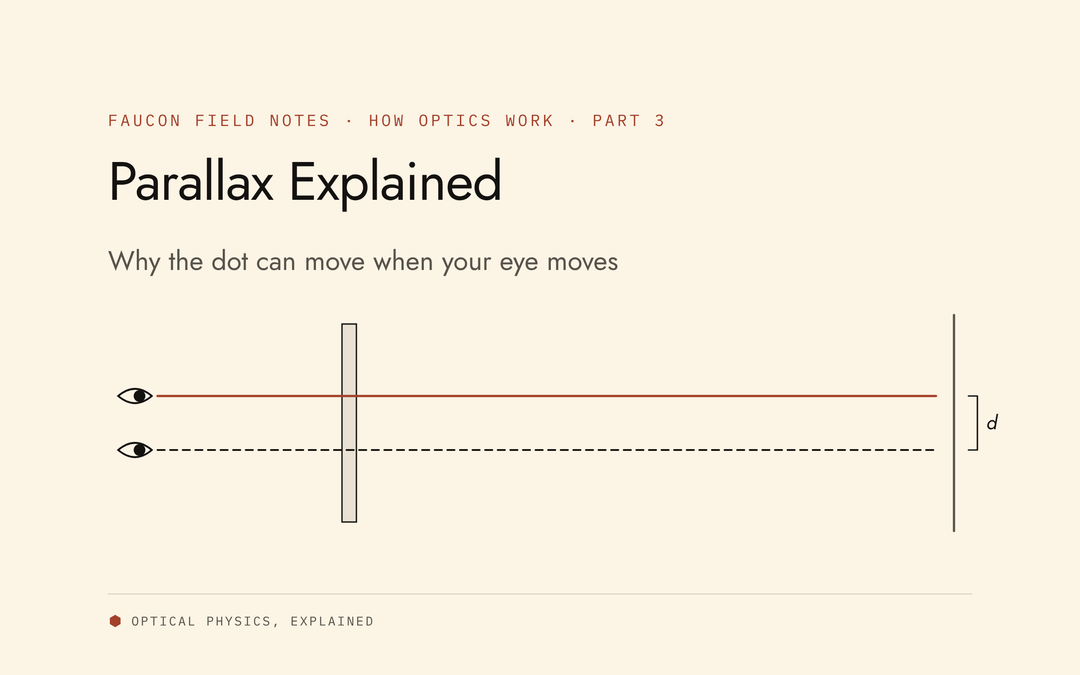
Suppose a sight sends perfectly parallel rays from its reticle, as if the reticle were infinitely far away. Every ray of reticle light leaves the window in the same direction, parallel to the sight's line of aim. Wherever the eye sits behind the window, it sees the reticle along a line parallel to that axis.
Now move the eye sideways by a distance d. The eye's line of sight to the reticle is still parallel to the axis, but it is displaced by d. Out at the target, the point under the dot is therefore d away from where the axis meets the target. That is true at every range. The offset at the target is a fixed linear distance equal to the eye's offset, so it can never be larger than the width of the window you are looking through. Wikipedia's summary of reflector sights puts it the same way: for targets at finite range, the error circle is equal to the diameter of the collimating optics (Wikipedia: Red dot sight; Wikipedia: Reflector sight).

Try itLet the eye sway with the image at infinity, then set the image to 50 m and slide the target nearer and further.
Figure 1. With a perfectly collimated reticle, moving the eye by d moves the point under the dot by d at the target, at any range. The angle that offset represents shrinks with distance. Schematic, not to scale. In the interactive, the 28 mm window and all offsets are illustrative.
Because the offset is fixed in length, the angular error it represents shrinks with range. For an illustrative 10 mm eye offset, the error is about 3.4 MOA at 10 m, 1.4 MOA at 25 m and 0.34 MOA at 100 m. (One minute of angle is about 0.29 milliradians.)
The real case: focused at a finite distance
As Part 2 showed, sights are often set so that the reticle image sits at a finite distance rather than at infinity. Vector Optics, for example, says its red dots are set to a "parallax setting distance" of 50 or 100 yards in production (Vector Optics Academy).
When the reticle image sits at distance P and the target is at distance D, the geometry changes. Lines of sight from different eye positions all pass through the reticle image at P. At the target, an eye offset d produces an offset of
offset = d × (1 − D/P)
This is our own derivation from similar triangles, and it behaves as you would expect. At D = P the offset is zero: the reticle and target are in the same plane, so there is no parallax. Nearer than P the offset is in the same direction as the eye's movement. Beyond P it reverses and grows, but the angle it represents approaches a limit of d/P.

Try itMove across the chart to read a value. Change the set distance and the eye offset to reshape the curve.
Figure 2. Angular offset against range for an illustrative sight set at 50 m, with the eye 10 mm off-centre. The error vanishes at the set distance, is largest up close, and levels off beyond it. Calculated from the geometry above, not measured on any product.
Two practical readings of the chart are worth making explicit, and neither is a matter of technique. First, a sight is only "parallax-free" at one distance, its set distance. Second, at close range the numbers can be larger than people expect, while at long range they stay small, because the linear offset is bounded by the window size.
Imperfect optics add their own share
The geometry above assumes perfect optics. Real collimating mirrors and lenses have aberrations, so the light from the reticle is not perfectly parallel across the whole window. Light reaching the eye from near the edge of the window may leave at a slightly different angle from light near the centre. Simple spherical reflectors, for instance, focus edge rays and centre rays slightly differently, which is one reason designers use corrected forms such as the Mangin mirror, a lens and mirror combined (Wikipedia: Red dot sight).
Maker figures show the effect is not zero. EOTECH's help centre says off-axis parallax in its holographic sights "might be up to 4±3 MOA (or a total of 14 MOA across the viewing window) at 71˚F," and that temperature extremes can add "an additional 4 MOA." It goes on: "It is a common misconception that red dot or holographic sights are parallax free" (EOTECH Help Center). Those are the maker's published figures for its own products. We have not measured them, and other designs will differ.
Magnified scopes: a different mechanism
In a magnifying telescopic sight, parallax has a different cause. The objective lens forms a real image of the target inside the scope, and the reticle sits at a focal plane. If the target's image does not fall exactly on the reticle's plane, the two shift against each other when the eye moves behind the eyepiece. Scopes with parallax adjustment (an adjustable objective or a side-focus knob) move the image plane so it falls on the reticle for a chosen range. In Wikipedia's description, the control is meant "to neutralize the focal difference between the target image and the reticle" (Wikipedia: Telescopic sight).

Try itTurn the side-focus knob until the target image sits on the reticle. The crosshair stops sliding.
Figure 3. Parallax in a magnified scope. When the target's image lies on the reticle plane (top), eye movement does not shift one against the other. When it lies off that plane (bottom), it does. Schematic, not to scale.
Wikipedia also notes that many low-power variable optics have no parallax adjustment, as their low magnification is mostly used at short and medium distances (Wikipedia: Telescopic sight).
Why "parallax-free" needs qualification
Putting this together, "parallax-free" is a statement with conditions attached. For any sight, it is worth asking:
- At what distance? A finite-set sight is free of parallax only where the target and the reticle image coincide.
- Over what part of the window? Aberrations mean the figure near the centre can differ from the figure at the edge.
- At what temperature? At least one maker publishes a larger figure at temperature extremes.
- Measured how? Is the figure an angular error (MOA or mrad) at a stated range, or a linear offset? The two convert differently with distance.
None of this makes reflex or holographic sights inaccurate. The geometry bounds the error, and for most viewing positions it is small. The point is that a claim of zero is a simplification. The honest version names the range, the window area and the conditions.
Key points
- Movement of the dot within the window is normal. Parallax error is movement of the dot against the target.
- A perfectly collimated sight turns an eye offset d into a fixed offset of d at the target, at any range.
- A sight set at distance P has an offset of d × (1 − D/P): zero at P, largest up close.
- Real optics add aberration-driven error. Maker figures confirm it is not zero.
- Magnified scopes have parallax when the target's image misses the reticle plane, which parallax adjustment corrects.
Sources
Every source below was opened and checked on 6 November 2026. Worked numbers and the finite-distance formula are our own geometry.
- Wikipedia, "Parallax": https://en.wikipedia.org/wiki/Parallax
- Primary Arms, "Parallax and red dots": https://blog.primaryarms.com/guide/parallax-and-red-dots/
- Wikipedia, "Red dot sight": https://en.wikipedia.org/wiki/Red_dot_sight
- Wikipedia, "Reflector sight": https://en.wikipedia.org/wiki/Reflector_sight
- Vector Optics Academy, "Parallax-free red dot sight": https://www.vectoroptics.com/Academy/parallax-free-red-dot-sight-vectoroptics.html
- EOTECH, Help Center (parallax FAQ): https://www.eotechinc.com/pages/help-center
- Wikipedia, "Telescopic sight": https://en.wikipedia.org/wiki/Telescopic_sight